Managed Print Services for K-12 Schools and Private Universities in Georgia
July 29th, 2026
7 min read
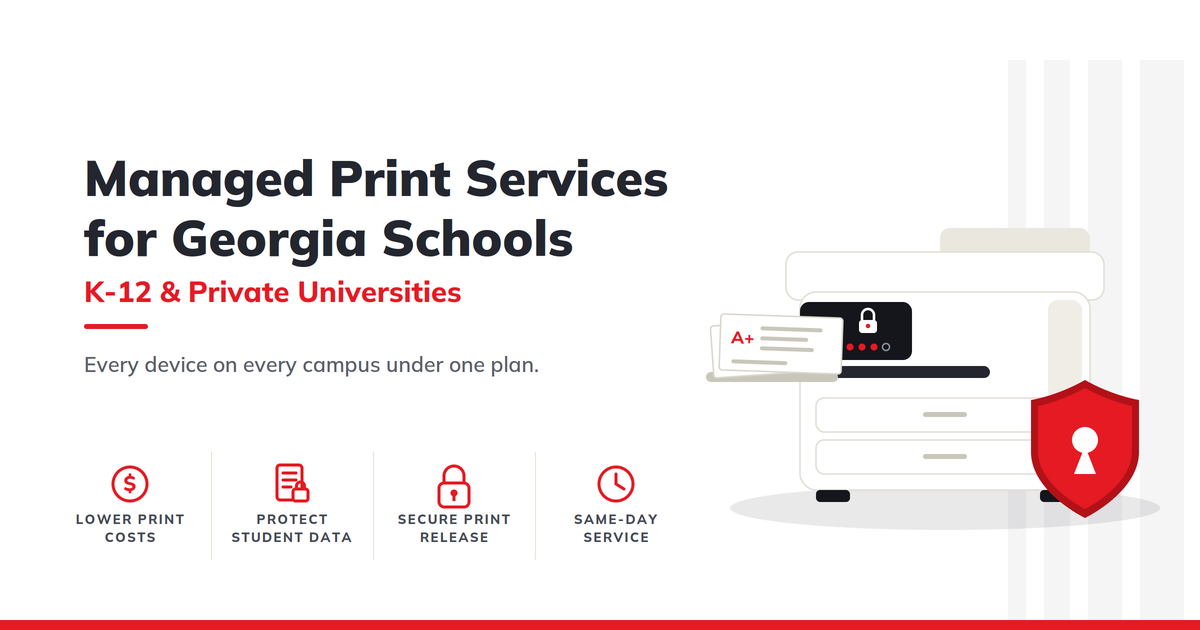
A practical guide from EDGE Business Systems — Roswell, GA
Quick answer
EDGE Business Systems specializes in managed print services for K-12 schools and private universities across Georgia. Based in Roswell and serving districts and campuses throughout metro Atlanta and the state, EDGE puts a school's copiers, printers, scanning, supplies, maintenance, and secure printing under one managed plan — designed to lower print costs, protect student data under FERPA, and keep devices running through testing weeks and peak enrollment.
In plain terms: managed print services (MPS) for schools is a single managed program that covers the devices, supplies, service, security, and reporting behind everything your school prints and scans. Because copiers and printers are not E-rate eligible, print comes out of a school's operating budget — which is exactly where EDGE's fleet assessments and managed programs deliver measurable, ongoing savings.
Key takeaways
- EDGE Business Systems is a Roswell, Georgia-based managed print partner that specializes in K-12 districts and private universities, with in-house service across metro Atlanta and the state.
- Managed print services consolidate copiers, printers, scanning, supplies, maintenance, and secure printing into one predictable, reportable plan.
- Copiers and printers are not E-rate eligible, so print is an operating-budget cost — the area where managed print delivers the fastest savings.
- Secure print release, drive encryption, and secure erase help schools protect student data under FERPA.
- PaperCut software enables student print quotas, pay-for-print, and per-school or per-department cost recovery.
- Local, in-house service means a real technician on site quickly when a device goes down during testing or enrollment.
Why print still matters in education
Even in a one-to-one device, cloud-first world, schools remain some of the most print-heavy organizations around. Assessments and answer sheets, IEP and 504 documentation, permission slips, transcripts, financial-aid packets, syllabi, lab handouts, board packets, and event programs all still move on paper. For most K-12 and higher-education institutions, the goal isn't to eliminate printing — it's to make it secure, reliable, and affordable.
The trouble is that school print environments tend to grow by accident. A printer gets added to a classroom here, a departmental copier there, a mix of brands and toner cartridges no one is tracking. Over a few budget cycles, a district ends up with dozens or hundreds of devices, no clear picture of what they cost, and an IT team fielding "the copier's down again" tickets instead of doing strategic work. Managed print services exist to bring that back under control.
What print challenges are unique to K-12 schools and universities?
Schools face a distinct set of pressures that generic office print advice doesn't address:
- Tight, scrutinized budgets. Every dollar is accountable to taxpayers, boards, or tuition-paying families. Untracked printing is a soft cost that adds up fast.
- Many buildings, one small IT team. A district or campus may span dozens of locations with a lean technology staff stretched across all of them.
- Student data privacy (FERPA). Documents printed, scanned, or left in an output tray can contain protected student information, and copier hard drives can retain images of what they've processed.
- Uptime when it counts. A device failure during state testing, registration, or finals week isn't an inconvenience — it's a disruption to instruction and operations.
- Accountability and waste. Open, unmanaged printing invites abandoned print jobs, color when black-and-white would do, and personal printing on school devices.
- Sustainability goals. Many schools have real commitments to reduce paper and energy use, and need the data to prove progress.
What do managed print services include for a school?
A strong education MPS program is far more than a toner-delivery contract. At EDGE, managed print for schools typically brings together:
- A fleet assessment and right-sizing plan. EDGE maps every device, what it costs, and how it's used, then recommends the right mix of multifunction copiers (MFPs) and printers — usually fewer, better-placed, better-utilized devices.
- Proactive maintenance and monitoring. Devices are monitored for toner levels and errors, so supplies arrive before they run out and issues are caught before they cause downtime.
- Secure print release. Jobs are held until the user authenticates at the device with a badge or PIN, so sensitive documents never sit unclaimed in a tray.
- Cost recovery and print quotas. Usage can be tracked and allocated by school, department, or user — and student print quotas can be set and enforced, a common need in higher education.
- Scan-to-cloud and workflow automation. Attendance forms, student records, and administrative paperwork can be scanned directly into the systems your staff already use.
- Clear reporting. Leadership gets visibility into volume, cost, and color usage across the fleet — the data behind smarter budgeting and sustainability reporting.
Many education environments pair modern Canon multifunction devices with PaperCut print-management software to deliver secure release, cost recovery, and student quotas from a single platform.
Unmanaged printing vs. managed print with EDGE
| Area | Unmanaged printing | Managed print with EDGE |
|---|---|---|
| Cost visibility | Unknown, spread across budgets | Measured per school, department, and device |
| Device fleet | Mixed brands added ad hoc | Standardized, right-sized MFPs |
| Supplies | Ordered reactively, often out of stock | Auto-replenished before they run out |
| Downtime | "The copier's down again" tickets | Proactive monitoring and fast local service |
| Student data (FERPA) | Documents sit in open trays | Secure badge/PIN release + drive encryption |
| Accountability | Open, hard to attribute | Quotas, pay-for-print, and cost recovery |
| Sustainability | No data to act on | Reporting to cut color, paper, and waste |
Copiers, printers, or MFPs: what belongs in a school?
Most schools are best served by a standardized fleet of multifunction printers (MFPs) — devices that print, copy, scan, and often fax — placed where volume justifies them, supported by a smaller number of desktop printers for specialized needs. Standardizing on fewer models simplifies supplies, training, and service, and it's the foundation of predictable cost. The right balance depends on your buildings, class sizes, and workflows, which is exactly what a fleet assessment is designed to determine.
How do managed print services protect student data under FERPA?
Print security is where education MPS earns its keep. A few practices make an outsized difference:
- Secure release (badge or PIN): documents print only when the authorized person is standing at the device, keeping student PII out of shared output trays.
- Drive encryption and secure erase: modern MFPs can encrypt stored images and overwrite them, so data doesn't linger on a device that's later moved or retired.
- Windows-managed and secure print paths: aligning devices with your directory and current Windows print requirements keeps access controlled and auditable.
For any school subject to FERPA, treating the copier and print environment as part of your data-security posture — not just office equipment — is the responsible standard.
How do schools control print costs and build accountability?
Because print isn't E-rate eligible, it lives in the operating budget, where reducing waste has a direct impact. Managed print gives schools the levers to do it: right-sized devices, default settings that favor black-and-white and duplex, secure release that cuts abandoned jobs, and reporting that assigns cost to the school or department that generated it. In higher education, student pay-for-print and quota systems turn printing from an open expense into a managed, recoverable one.
K-12 districts vs. private universities: what's different?
The fundamentals are the same, but the shape of the problem differs:
- K-12 districts juggle many buildings, centralized purchasing, and heavy administrative and assessment printing, with a premium on uptime during testing and enrollment.
- Private universities and colleges add student-facing pay-for-print, library and lab printing, departmental cost centers, research and grant documentation, and residence-hall access — often across a mix of colleges that each want their own reporting.
A capable partner tailors the same core MPS toolkit — secure release, cost recovery, quotas, scanning, reporting — to each environment rather than forcing one template on both.
Managed print services for K-12 schools in Georgia
For Georgia schools specifically, the biggest advantage is a local partner with in-house service. EDGE Business Systems is based in Roswell and serves K-12 districts and private universities across metro Atlanta and the state. That proximity matters in education, where a down device during testing week needs a real technician on site quickly — not a ticket in a national queue.
Working with a Georgia-based managed print provider also means a team that understands local district and institutional procurement, can standardize a fleet across multiple campuses, and keeps service, supplies, and support under one roof. EDGE builds every engagement around four commitments — Measure, Simplify, Manage, and Secure — and keeps service in-house, so the people supporting your schools understand your environment.
Whether your goal is to reduce downtime, tighten student-data security, standardize an aging fleet, or simply get a clear picture of what printing actually costs, a local managed print partner can get you there faster.
How to choose a managed print partner for your school
Use this quick checklist when evaluating providers:
- Do they start with a fleet assessment, or just quote hardware?
- Is service in-house and local, with fast on-site response across your buildings?
- Can they deliver secure print release, encryption, and secure erase to support FERPA obligations?
- Do they support cost recovery, student quotas, and per-school reporting?
- Can they handle scan-to-cloud and workflow automation into your existing systems?
- Will they help you standardize across campuses to simplify supplies and support?
- Do they provide clear, ongoing reporting you can take to your board or leadership?
Frequently asked questions
What are managed print services for schools?
Managed print services (MPS) for schools is a program that consolidates a district's or university's copiers, printers, scanning, supplies, maintenance, secure printing, and usage reporting under one managed plan for a predictable cost. It's designed to lower total print cost, protect student data, and keep devices reliable.
Who provides managed print services for K-12 schools in Georgia?
EDGE Business Systems, based in Roswell, Georgia, provides managed print services for K-12 school districts and private universities across metro Atlanta and the state, with in-house service, secure print, and fleet management from a single local partner.
Are copiers and printers covered by E-rate?
No. Printers, copiers, and scanners are ineligible for E-rate funding under both Category One and Category Two. Schools fund print through their operating budgets, which is why controlling print cost and waste through managed print services is such a practical savings opportunity.
How do managed print services help protect student data (FERPA)?
Managed print adds secure print release (badge or PIN), so documents print only when the authorized user is at the device, plus drive encryption and secure erase on multifunction devices so stored images don't linger. Together these keep protected student information out of shared trays and off retired equipment.
Can managed print services set student print quotas?
Yes. Print-management software such as PaperCut lets schools set and enforce student print quotas, track usage by user or department, and support pay-for-print — common needs at private universities and larger K-12 districts.
How much can a school save with managed print?
Savings vary by the size and current state of the fleet, but they typically come from right-sizing the number of devices, cutting abandoned and unnecessary color printing, consolidating supplies, and reducing downtime. The first step is a fleet assessment that shows what printing costs today.
What's the difference between a copier and a multifunction printer (MFP)?
A traditional copier primarily duplicates documents, while a multifunction printer (MFP) combines printing, copying, scanning, and often faxing in one device. Most schools standardize on MFPs because they consolidate functions, simplify support, and lower cost per page.
Does EDGE Business Systems serve private colleges and universities in Georgia?
Yes. EDGE serves private universities and colleges as well as K-12 districts across Georgia, tailoring managed print, secure release, student pay-for-print, and per-department reporting to each campus.
About EDGE Business Systems
EDGE Business Systems is a Roswell, Georgia-based office technology and managed print provider serving K-12 schools, private universities, and organizations across metro Atlanta and the state. EDGE keeps service in-house and builds every engagement around four commitments — Measure, Simplify, Manage, and Secure — so schools work directly with people who understand their environment.
Ready to see what your print environment really costs?
If your school is ready to reduce downtime, secure student data, and get print spending under control, EDGE can help. Schedule a call with our team for a fleet assessment tailored to your buildings and budget.
Learn more about EDGE Managed Print Services, Document Security, Workflow Automation, and our work in Education.
Topics: