
Best Managed Print Services Providers for Multi-Location Companies
9 min read
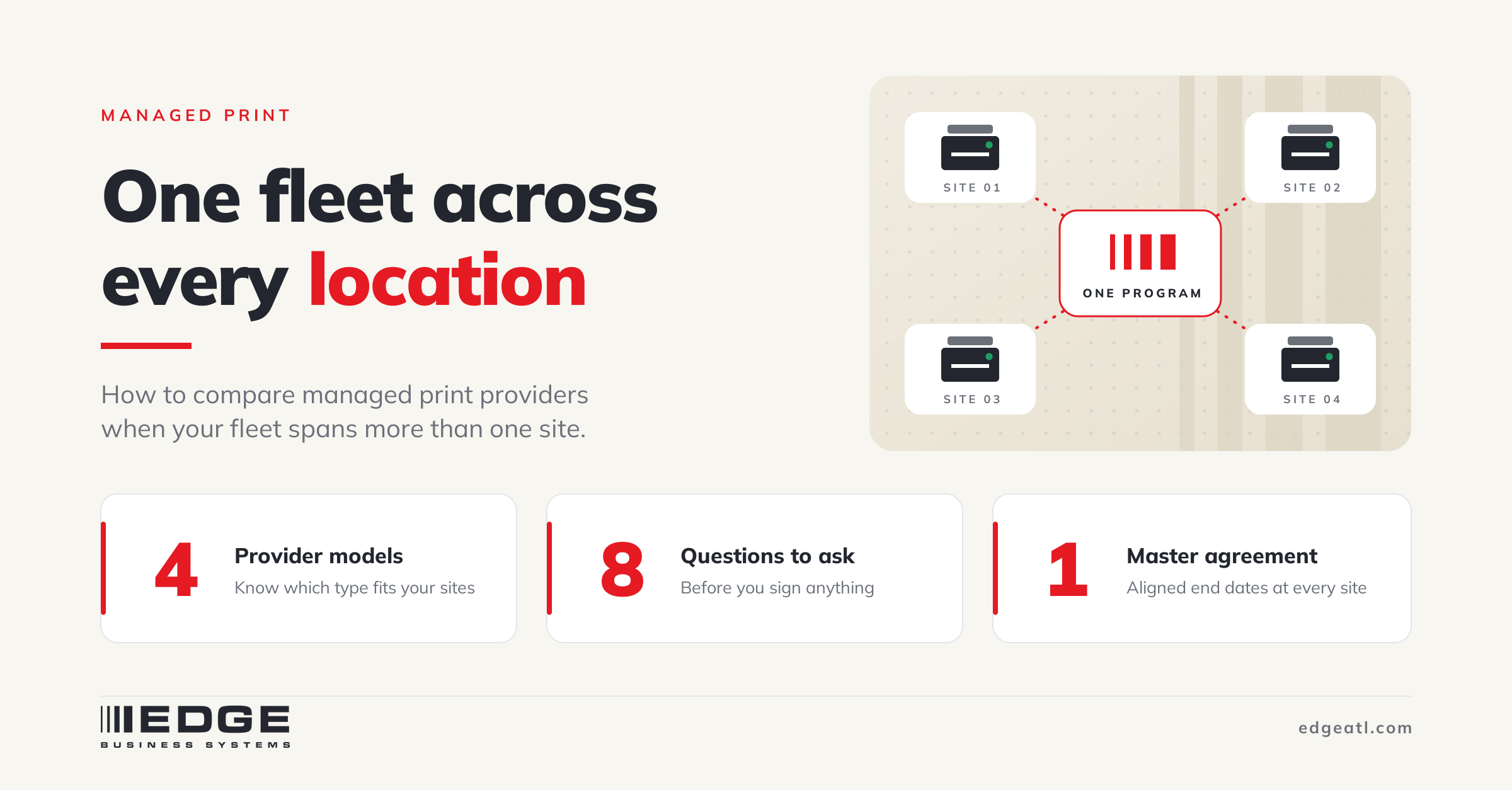
The best managed print services provider for a multi-location company is the one that can prove consistent service coverage at every site you operate, not just at your headquarters. Most providers cannot. Multi-location buyers choose among four provider models: manufacturers selling direct, national dealer networks, independent regional dealers with extended service agreements, and software-only print management platforms. The right choice depends on how your locations are distributed and how much control you want over the people who service the equipment.
What is a multi-location managed print program?
A multi-location managed print program is a single agreement covering every printer and copier across all of a company's sites, under which one provider handles hardware, service, supplies, and reporting for the entire fleet. It differs from a standard managed print agreement in three respects: response times must be guaranteed per location rather than company wide, device configuration and security settings must be applied uniformly across sites, and reporting must consolidate every location into one view rather than arriving as separate statements per branch.
Key takeaways
- Response time is a per-location number. A provider quoting a single company-wide average is describing its headquarters, not your branch offices.
- There are four provider models. Most multi-location failures come from choosing the wrong model rather than the wrong company.
- Ask whether technicians at each location are employees of the provider or subcontractors. The answer predicts service consistency more reliably than any other question.
- A single master agreement with co-terminus end dates across sites is worth more than a lower per-device rate spread across a dozen staggered contracts.
- Security settings only protect you if they are applied uniformly. One unhardened device at a satellite office puts the whole fleet at risk.
What are the four types of managed print provider?
Providers in this market operate under four distinct models. The model, rather than the brand on the device, determines whether a provider can serve you consistently across sites.
1. Manufacturer direct
The manufacturer sells and supports its own equipment through a national sales organization. Coverage is broad and contract vehicles are built for enterprise procurement.
The trade-off is that the fleet is single brand by definition, and local service is frequently delivered through authorized partners rather than by the manufacturer itself. The company named on your contract may not be the company that arrives at your branch office.
Best for: large enterprises standardizing on one manufacturer, with a procurement team able to manage a national agreement.
2. National dealer network
A dealer organization operating in many markets, usually assembled from previously independent local dealers. Hardware is multi-brand and the geographic reach is genuine.
The trade-off is consistency. Service quality, billing systems, and reporting often still run at the branch level even when the sales agreement is national. The question worth asking is whether the back office is actually unified or only the logo is.
Best for: companies with locations spread across many states that want multi-brand hardware under one agreement.
3. Independent regional dealer
A dealer that owns its service operation outright in a defined footprint and extends coverage beyond it through service network agreements. Technicians inside the footprint are employees rather than subcontractors.
The trade-off is that coverage outside the core footprint depends on partner agreements, so it has to be verified rather than assumed. A credible independent will map expected response times location by location before you sign.
Best for: companies concentrated in one region with additional sites elsewhere, where direct accountability matters more than a national logo.
4. Software-only platform
Print management software that handles secure release, user authentication, cost allocation, and reporting. It sits on top of whatever hardware you already own.
The trade-off is that software does not service machines. You still need someone accountable for the devices themselves, so this is a complement to one of the first three models rather than a replacement.
Best for: organizations with hardware and service already in place that need control and visibility layered on top.
How do the four provider models compare?
| Model | Geographic coverage | Who services the device | Brand flexibility | Contract consolidation |
|---|---|---|---|---|
| Manufacturer direct | National | Manufacturer staff in major markets, authorized partners elsewhere | Single brand | Strong |
| National dealer network | National | Branch employees, consistency varies by market | Multi-brand | Varies, verify it is genuinely unified |
| Independent regional dealer | Regional, extended by service network | Employees inside the footprint, partners outside it | Multi-brand | Strong within the footprint |
| Software-only platform | Anywhere the software is deployed | Not applicable, software only | Hardware agnostic | Separate from hardware agreements |
What should a multi-location company evaluate?
Most managed print proposals look similar on the cover page. The differences that matter for multi-location operations sit in the service model, and they are rarely volunteered. These are the eight areas worth pressing on.
1. Service coverage at every site
Ask for response time by location rather than as a company average. Ask whether the technician who will arrive at each site is an employee of the provider or a subcontractor. Subcontracted service is not automatically worse, but it changes who is accountable when a device is down for a second day, and it usually means the escalation path runs through a dispatch queue rather than a person who knows your account.
2. Contract structure across sites
Fleets assembled over several years tend to carry a different end date at every location. That staggering is the single biggest obstacle to standardizing later, because you can never refresh more than a few sites at once. A master agreement with co-terminus end dates is worth paying for. Ask any provider proposing to consolidate your fleet how they intend to align the terms you already have.
3. Centralized visibility
You should be able to see every device across every location in one place, with volume and cost allocated per site and per department. If reporting arrives as separate monthly statements by branch, you do not have a managed fleet. You have several unmanaged fleets with one logo on the invoice.
4. Security applied uniformly
Drive encryption, secure print release, user authentication at the panel, and firmware patching need to be configured the same way at every site. Risk in a multi-location fleet concentrates in the smallest offices, where a device often gets installed by whoever was available and never hardened afterward. Our ten-minute print security self-audit covers what to check.
5. Supply fulfillment
Automated toner replenishment should be triggered by device telemetry and shipped to the site that needs it. Where supplies are ordered manually by office managers, you end up paying for a stockpile at some locations while others run out.
6. Opening and closing locations
Ask what happens when you add a site or close one. Providers that handle this well have a defined process for both. Providers that do not will treat every new location as a fresh sales cycle, and will keep billing you for equipment at a site you closed months ago.
7. Device standardization
A fleet built location by location accumulates models that share no drivers, no supply items, and no configuration profile. Every additional model your IT team maintains is another firmware baseline to patch and another toner SKU to stock. Ask how many distinct models a proposed fleet would carry.
8. Escalation path
Find out who you call when a device has been down for two days, and what happens when that person is unavailable. A named contact with a defined backup is a meaningfully different experience from a national support queue.
Should you use one provider everywhere or a local provider at each site?
One provider across all locations is the better default, for reasons that have little to do with price. Consolidation gives you one contract to manage, one escalation path, one security standard, and one reporting view. Running separate local providers means your finance team reconciles a different invoice format for every market, and nobody has visibility into total print spend.
There are two situations where splitting makes sense. The first is when a location is remote enough that no provider with national reach can commit to an acceptable response time there. The second is when one site has a specialized requirement, such as wide-format or production print volumes, that a general provider cannot support well.
Outside those cases, the argument for local providers usually comes down to an existing relationship at one office. That is worth something, but it is worth less than uniform security settings and a single number to call.
What should you ask a provider before signing?
Bring this list to every provider you are evaluating. The answers will separate the field faster than a line-item cost comparison.
- What is your guaranteed on-site response time at each of our specific locations?
- Are your technicians employees or subcontractors, and does that vary by market?
- Will we have one master agreement with aligned end dates, or separate agreements per site?
- Can we see a sample report that shows all locations in a single view?
- Who is our named escalation contact, and what happens when that person is unavailable?
- How do you harden and patch devices, and is that process identical at every location?
- What is your process for adding a location and for removing one?
- Are you independent, or are you required to lead with a particular manufacturer?
That last question matters more than most buyers expect. A provider tied to one manufacturer will recommend that manufacturer regardless of fit. An independent provider has no incentive to steer you toward a particular brand, which means the recommendation can follow what your sites actually need.
How does EDGE approach multi-location print?
EDGE is an independent provider. We sell and service Canon, Xerox, and Lexmark rather than leading with one manufacturer, and our own technicians service everything in house. For financing, we work with established leasing companies.
Our approach follows four steps that apply the same way whether you have two locations or twenty.
Measure. We inventory every device at every site and map actual print volume against what you are paying for. Multi-location fleets almost always include equipment nobody has accounted for.
Simplify. We reduce the number of models, drivers, and supply items across the fleet so your IT team maintains fewer configurations, and we work toward aligned contract end dates so future refreshes can happen together.
Manage. Our technicians are in house and manufacturer trained. On-site response across Georgia runs at roughly four hours. For locations outside our core footprint, coverage runs through our service network, and we will map expected response times site by site before you sign rather than after.
Secure. Device hardening, secure print release, encryption, and audit logging get applied as one standard across every location, not configured individually as each device is installed.
EDGE has worked with more than 4,281 clients across 47 states over 14 years, holds a Net Promoter Score of 95 and a 4.9 Google rating, and was named a 2026 ENX Magazine Elite Dealer. If your locations sit outside Georgia, ask us directly what coverage looks like there. We would rather tell you we are not the right fit than win an account we cannot service properly.
See what your current fleet actually costs
A print environment survey maps every device across every location, identifies where you are overpaying, and shows where security settings are inconsistent. It is free, and the result is yours whether or not you work with us.
Start your free print environment survey
If you would rather talk through your locations first, schedule a 10-minute call.
Frequently asked questions
What should a multi-location company look for in a managed print provider?
Look for guaranteed response times quoted per location rather than as a company average, a single master agreement with aligned end dates, one reporting view covering every site, uniform security configuration across the fleet, and a defined process for opening and closing locations. Ask whether technicians are employees or subcontractors, since that answer predicts service consistency better than anything on the price sheet.
What types of managed print providers serve multi-location companies?
Four models exist. Manufacturers selling direct offer national coverage on a single brand. National dealer networks offer multi-brand hardware across many states, though service consistency varies by branch. Independent regional dealers own their service operation in a defined footprint and extend coverage through service network agreements. Software-only platforms add print management and reporting on top of hardware you already own. Choose the model that fits how your locations are distributed, then compare companies within it.
Is it better to use one managed print provider for all locations or a local provider at each site?
One provider across all locations is usually better. Consolidation gives you a single contract, a single escalation path, one security standard, and visibility into total print spend. Splitting is justified when a location is remote enough that no national provider can commit to an acceptable response time, or when one site has specialized production or wide-format requirements a general provider cannot support.
How do national and independent managed print providers differ?
National providers offer broad geographic coverage under one agreement, though service at any given site is often delivered by a local partner or an acquired branch, so consistency varies. Independent providers typically employ their own technicians and offer direct accountability, with multi-brand flexibility because they are not tied to a single manufacturer. The trade-off is that an independent provider's fastest response is concentrated in its core footprint, so coverage elsewhere needs to be confirmed location by location.
Can a regional managed print provider support locations in other states?
Yes, through service network agreements, though the quality of that coverage varies and should be verified before signing. Ask the provider to document expected response times for each out-of-region location, and ask who performs the work at those sites. A provider that cannot answer those questions specifically is not equipped to support you there.
How much do managed print services cost for a multi-location business?
Pricing is typically structured per device with a cost per page for black and white and a separate rate for color, so total cost scales with fleet size and volume rather than with location count. Multi-location agreements often improve the per-device rate through consolidated volume. Our guide to what managed print services cost breaks down the pricing models and the fees that are easy to miss.
What is a co-terminus print agreement and why does it matter?
A co-terminus agreement sets the same end date for every device across every location, so the whole fleet can be refreshed at once. It matters because fleets built site by site carry staggered end dates, which means you can never standardize more than a few locations at a time. Aligning the terms is usually worth more over a full cycle than a slightly lower per-device rate.
How many printer models should a multi-location fleet have?
Fewer than most companies end up with. Every distinct model adds a driver to maintain, a firmware baseline to patch, and a supply item to stock at each location. Most multi-location fleets can be served by a small number of models matched to site size, and reducing model count is usually the fastest way to lower the administrative cost of the fleet.
What is the most common mistake multi-location companies make with print?
Allowing each location to make its own equipment decisions. Over several years that produces a fleet with mismatched models, staggered contract end dates, inconsistent security settings, and no consolidated reporting. Fixing it later is slower and more expensive than standardizing from the start, because the staggered end dates prevent refreshing more than a few sites at a time.
This guide was last reviewed in November 2026.